|
News Feed
|
 LinuxHPC.org.org has an RSS/RDF feed if you wish to include it on your website. LinuxHPC.org.org has an RSS/RDF feed if you wish to include it on your website.
|
 |
|
Linux Cluster RFQ Form
Reach Multiple Vendors With One Linux Cluster RFQ Form. Save time and effort, let LinuxHPC.org do all the leg work for you free of charge. Request A Quote...
|
|

|
LinuxHPC.org is Looking for Interns - If you have experience with Linux clusters and/or cluster applications and you're interested in helping out with LinuxHPC.org let me know. I can promise the experience will be rewarding and educational, plus it'll make good resume fodder. You'll work with vendors and cluster users from around the world. We're also looking for writers and people to do hardware/software reviews. Contact Ken Farmer.
|
|
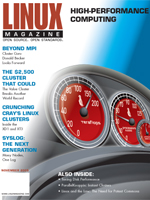
Linux Magazine: Journaling File Systems
|
|
Monday January 06 2003 @ 07:51AM EST
|
|
The file system is one of the most important parts of an operating system. The file system stores and manages user data on disk drives, and ensures that what's read from storage is identical to what was originally written. In addition to storing user data in files, the file system also creates and manages information about files and about itself. Besides guaranteeing the integrity of all that data, file systems are also expected to be extremely reliable and have very good performance.
For the past several years, Ext2 has been the de facto file system for most Linux machines. It's robust, reliable, and suitable for most deployments. However, as Linux displaces Unix and other operating systems in more and more large server and computing environments, Ext2 is being pushed to its limits. In fact, many now common requirements -- large hard-disk partitions, quick recovery from crashes, high-performance I/O, and the need to store thousands and thousands of files representing terabytes of data -- exceed the abilities of Ext2.
Full story...
|
|
|
|
|




 SpyderByte.com